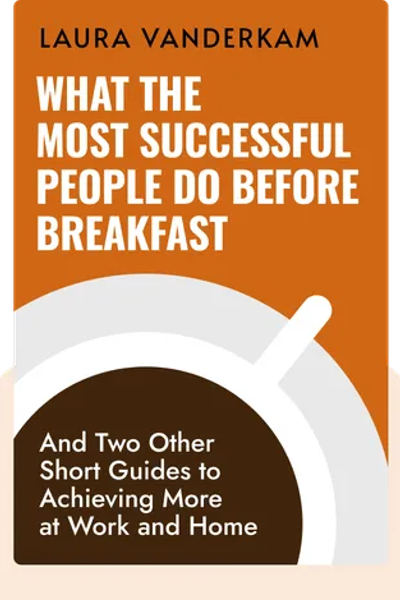
What the Most Successful People Do Before Breakfast
Laura Vanderkam
What It's About
Mornings are a madcap time for many of us. We wake up in a haze—often after hitting snooze a few times. Then we rush around to get ready and out the door so we can officially start the day. Before we know it, hours have slipped by without us accomplishing anything beyond downing a cup of coffee, dashing off a few emails, and dishing with our coworkers around the water cooler. By the time the workday wraps up, we’re so exhausted and defeated that any motivation to accomplish something in the evening has vanished.
But according to time management expert Laura Vanderkam, mornings hold the key to taking control of our schedules. If we use them wisely, we can build habits that will allow us to lead happier, more productive lives.
Drawing on real-life anecdotes and scientific research that shows why the early hours of the day are so important, Vanderkam reveals how successful people use mornings to help them accomplish things that are often impossible to take care of later in the day. While many of us are still in bed, these folks are scoring daily victories to improve their health, careers, and personal lives without sacrificing their sanity. For instance, former PepsiCo chairman and CEO Steve Reinemund would rise at 5:00 a.m., run four miles, pray, and eat breakfast with his family before heading to work to run a Fortune 500 company.
What the Most Successful People Do Before Breakfast is a fun, practical guide that will inspire you to rethink your morning routine and jump-start your life before the day has even begun.
My Thoughts
I consider this a book with wholesome content. I learnt a lot.
- I am prioritizing my mornings for things that matter most to me.
- I’d take it easy on myself as I take on these new habits.
- From the list of habits I have set up, I’d take one perhaps per week and then incrementally over the coming weeks.
- I’d track how I spend my time.
- I take visualizing my morning more seriously.
- I engage in activities that don’t have immediate effect but would bring about positive change for me in the long run.
- When I stick to these activities, I build something that really makes a difference.
- I take my career capital seriously such as my work experience, network, skills, professional relationship as it is a leverage for building trust and gaining opportunities.
- My weekends are for rest and leisure activities that I don’t have time for.
- I anticipate my weekends. My weekends are my breaks.
In the course of reading this I looked up for a blink that perhaps spoke on something relating on how to plan my week. I didn’t find any. However, in the course of reading this blink and the authors’ bio — she had writing a book called ‘The 168 hours’. I’d also go through it some time soon.
Notes
What’s in it for me? Time management tips to get most out of your mornings.
There’s always time to do what you really want to. The trick is knowing where to look. And that’s something that worlds most successful high-flyers know all about.
Ask any one of them where they find the extra time to nurture their careers, relationships, and personal dreams, and they’ll give you a three-word answer. In the morning. All it takes is careful planning, mindfulness about how you spend your time, and a bit of self-discipline. Master that, and you’ll be amazed by how much you can fit into your daily schedule.
Start the day by immediately doing the things that matter most to you rather than putting them off.
Start the day by immediately doing the things that matter most to you rather than putting them off. Rethink your mornings, and they can become an opportunity to do the things that matter most. The key is to stop postponing important tasks. Do them now rather than waiting for the perfect moment later on. Everyone wants more time to do things they care about.
Mornings are the perfect time to accomplish your goals.
The best morning routines are about getting non-urgent but important things done.
The best morning routines are about the things that matter to you but require little bit of extra self-motivation. These are the kinds of activities that don’t have an immediate payoff but just change your life in the long run. Think of a creative project like writing a book or networking to support your career. It’s not something you can finish in one go.
This is exactly what the most successful people do every day. They spend their mornings nurturing one of three things — their careers, their relationships, or themselves.
Starting with career:
⇒ Nurturing your work life isn’t about quickly responding to emails as they land in your inbox.
⇒ Nurturing your work life is about attending to activities that you rarely have enough time for over the course of a normal day.
Get into the habit of using mornings to spend quality time with your family and practice self-care.
Career is important, but it’s just one of the pillars that support a fulfilling life. Relationships are another pillar.
Mornings are actually the perfect opportunity to spend time with those you love. After all, you won’t be drained after a long day in the office or longing to vegetate in front of the TV.
The third pillar you need to take care of if you want a more balanced life. Self-care. Me-time is usually one of the first things to get sacrificed when life gets hectic.
Responsibilities, work, and social commitments often trump the time you’ve earmarked for yourself. The answer is to free up time for self-nurture in the morning. Ask yourself what is it that really matters to you. Some people want to train for a marathon, others want to read more, write poetry, meditate, or paint. By getting up early, highfliers made time to do what they loved.
Start transforming your morning routine by tracking your time and envisaging your ideal morning.
Five (5) key steps to start putting your new morning routing into action
- Start making your morning more productive by recording how you spend your time over the week:
⇒ A week has 168 hours. If you want to get the most out of that and improve your time management, you need to know where all that time is going. The problem isn’t usually how you spend your mornings, but what you do with the rest of the day.
⇒ Late nights are especially detrimental to your ability to make an early start, but it’s easy to fall into the trap. Burning the candle at both ends isn’t viable in the long run. Eventually, you’ll be too tired to get up early.
⇒ That’s step one. Grab a notebook and start tracking you time.
2. Consider your ideal morning:
⇒ To do that, ask yourself what your perfect start to the day would look like.
⇒ Now that you’ve made a record of how you use your time, you can start envisioning how things could be different.
⇒ The key is to start picturing what an ideal start to the day looks like for you.
Consider the logistics of your ideal routine and take your time adopting new habits.
- Logistics:
⇒ It’s about figuring out if your ideal morning routine is doable.
⇒ Start by calculating how much time you’d actually need for it.
⇒ Can you make changes in other areas to accommodate your new plans?
2. Creating new habits: Start slow and be patient.
⇒ Sometimes it takes weeks to get into the groove of a new routine.
⇒ Taking your time is especially important because you don’t want to feel overwhelmed by the end of the first fortnight.
⇒ Not taking on too much will help keep your motivation levels high enough to get through this rough patch.
⇒ So if you’ve decided you want to spend your mornings running, meditating, and writing, start by doing just one of those activities. You can always add others later on.
⇒ Rewards — or bribes — are also useful when it comes to motivation.
⇒ If you’ve done well and stuck to your plan, give yourself a treat. That could be something like opera tickets or a meal in a nice restaurant.
3. Fine-tuning your routine:
⇒ If you want your new routine to stick, you’ll have to be adaptable and learn to make constant adjustments and readjustments.
⇒ Take it from the author, an avid morning runner. When she was expecting her first daughter, she had to change her regimen. Running just wasn't possible as her pregnancy progressed, so she put it on the back burner and devoted more time to nurturing herself.
Plan weekend activities ahead of time and savor the sense of anticipation.’
Weekend are your opportunity to get some well-deserved rest and recharge your mental and physical batteries, which are integral to your well-being. But it’s all too easy to waste these precious hours on a random hodgepodge of activities.
Rather than spontaneously deciding what to do come Saturday morning, make a list of between three and five anchor activities a couple of days in advance. That’s a good way of avoiding one of the classic ways of wasting a weekend. Doing nothing, something that’s always an attractive option at the end of a draining week.
If you want to get the most out of your weekend, make sure to plan out of the ordinary activities and learn to savor the sense of anticipation as the week winds down. The point of weekends is that they’re not like the rest of the week. What you need is a break.
It’s important to do things you wouldn’t do on any of the other five days.
Make your weekend plans special by writing a list of actionable dreams and embracing spontaneity.
There are lots of different ways of planning your weekend.
⇒ The first tip is to make a list of your top 100 dreams :
If you only listed your top 10 dreams, you'd likely end up with extravagant wishes like visiting the ancient ruins of Mexico or having a private dinner in the Louvre. There's nothing wrong with dreaming big, of course, but you're unlikely to do anything as extravagant as that on an average weekend. Once you start extending the list, however, you'll get to the things you can do on a regular Saturday or Sunday. That might be something like drinking a huge strawberry milkshake while your kids are busy playing in the park.
⇒ Grab a notebook and start writing:
Planning doesn't mean accounting for every second. Loose plans are fine, so keep it simple.
⇒ There’s downtime:
Weekends are your chance to rejuvenate. If you want to get some rest, plan it in.
Follow these tips, and you'll soon be enjoying restful and pleasurable weekends that set you up for the week ahead.
Boost your chances of success at work by keeping a log of how you spend your hours in the office.
Test your chances of success at work by keeping a log of how you spend your hours in the office. How much time do you spend working, sleeping, and doing chores? Tally it up, and then ask yourself a question.
Are you really sure that's right? Most people think they know where their hours go. But it's common to overestimate some things.
The trick is to learn to mind your hours. This technique will help you optimize your time management at work. Pay careful attention to your hours, and you might realize that you actually work a 50-hour, not an 80-hour week. There's a simple enough reason for these kinds of assumptions. People overestimate the time it takes to do things they don't like, and underestimate the time they spend doing things they do like. That's why chores or writing emails seem to take an age, but you never feel as though you've gotten enough sleep.
Keeping a time log will give you a much more realistic overview of your days. Aim to record your allotment of time over an entire week, making a note of all the hours spent working, tidying, and so on. You can use a spreadsheet or an app if it helps. Once you've done that, you're ready for the next step.
So pencil in some planning time into your calendar. You'll find that when you plan for things to happen, they usually do.
Achieve success by planning for it and cutting out “work” that doesn’t bring you anything.
Success is the fruit of planning. To be successful, you first have to make success possible.
Laying the groundwork for success is all about carefully choosing your priorities for the day ahead, every day. To do you need an accountability system that won’t let you down.
Let’s start with the first part.
Setting lofty goals is all well and good, but it means you’ll often end up falling short. That’s because there’s no way for you to achieve them on a daily basis.
Accountability is the second key to achieving success.
⇒ It’s all about sharing your aims with someone else.
⇒ Call them accountability partner.
⇒ Their role is to check in and let you know whether you’ve met your daily or weekly targets.
Cut out tasks that feel like work but don’t actually achieve anything.
⇒ Think of emails.
⇒ Writing and answering a hundred messages is part and parcel of today’s digital world. ome of them are essential, of course, but it's easy to end up feeling utterly swamped while not really getting anything done. Sometimes, it's better to shut your inbox and get down to what really matters. Cut out distractions and you'll find that the really important tasks actually take far less time than you'd imagined.
Success in the workplace is about practice, depositing career capital and looking for pleasure.
Time-honored truths it might be useful to remind yourself of.
- Practice makes perfect:⇒ One of the greatest obstacles to improvement is running on autopilot.
⇒ If you want to improve, you need to practice deliberately.
2. Keep a deposit of career capital you can use for future opportunities:
⇒ Career capital is basically everything you’ve earned so far during you work life — your experience, networks, skills, and professional personality.
⇒ Think of it as a currency you can use to buy new opportunities, such as promotion.
⇒ Keeping your account well-stocked means that you’ll be able to afford more.
⇒ One of the best ways of making sure your account is in the black is to nurture your relationships.
⇒ It’s about establishing trust. When people know they can rely on you, they’re much more likely to pass on tips and throw in good word for you.
3. Happiness:
⇒ The more attentive you are to signs of success, the happier you’ll be.
⇒ That's backed up by a study carried out by Harvard Business School professor Teresa Amabile and developmental psychologist Stephen Kramer. In their book The Progress Principle from 2012, they looked at 12,000 diary entries by different teams in several organizations across the United States.
⇒ Noticing signs of success, like positive feedback or a eureka moment during a difficult project is sure to make you happier too.
Final Summary
The key message is that proper time management won’t just make your mornings less hectic and keep your stress levels down. It’ll also boost your productivity in the office and help you get most out of the weekends.
The key is learning how tot keep track of time. Once you know where all that time goes, you can start making plans to use your hours more efficiently.
Take it slow and easy on the to-dos.
Weekends are all about rejuvenation. They’re your chance to take some tome out and recharge your batteries. That doesn’t just mean getting rest, though.
Like holiday, they’re about doing the things you don’t have time for in your everyday life.
So don’t spoil them by having a endless list of chores. Think about what you’d really like to do. What ever it is, make your plans and stick to them.